
From 7,000 to 3,000: what Klarna's AI journey tells everyone else
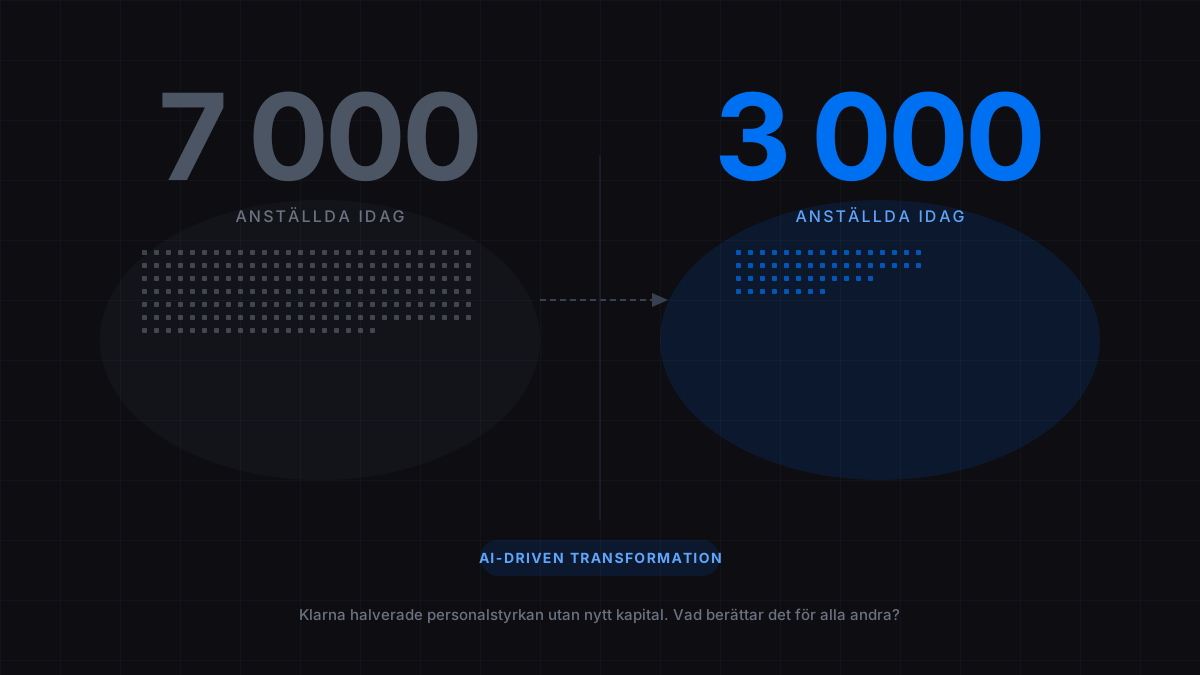
Sebastian Siemiatkowski sits in a podcast studio and says, calmly, that Klarna has gone from 7,000 employees to below 3,000. Without raising new capital. Without a named transformation programme. What does that tell everyone else?
How it actually started
It starts with customer service. In 2023, Klarna announces that their AI is handling the equivalent of 600 agents' work. Journalists run with the headline. Siemiatkowski later corrects the picture: it was mostly simple questions. "Did I pay? Yes. Thank you." Nothing technically impressive.
But the signal was clear. Klarna had never seen a product improvement that immediately removed an entire layer of work. Not gradually. Not through a managed wind-down. It just happened. And they understood that it was a beginning, not an end.
What they learnt from it matters. AI agents need context to work well. That context lives in source code and data. And that data was spread across a dozen SaaS systems with separate data models. The solution was not to buy a better customer service tool. It was to rebuild the tech stack from scratch, AI-native, with a single operating system for the whole company.
Result: 7,000 to below 3,000. Without asking for more capital. And Siemiatkowski speculates it could go lower still by 2030.
The data stack as the next battleground
Something he raises that has not got enough attention: switching costs for data.
Today, business data sits locked inside CRM systems, ERPs, WMS platforms and a dozen SaaS tools, each with its own data model. That makes switching vendors expensive. It also makes it difficult to give AI agents the right context. And poor context produces poor results.
What comes next: agents that migrate data between systems without manual work. When switching costs disappear, a large part of the value traditional SaaS companies have built on disappears with them. That is not speculation. You can already see it in how SaaS companies are being valued on the market.
That is why Klarna is actively closing down SaaS contracts. Not because SaaS is a bad category, but because isolated data silos make AI agents worse. And worse agents cost more to run.
The gap most companies get stuck in
Klarna is a tech-first company with hundreds of engineers and full control of its tech stack. They can build this.
Most companies cannot.
But what Siemiatkowski describes is not really about building. It is about rethinking what work actually is. Every ticket, every invoice, every product data update is a transaction with a defined input and an expected output. If you can specify it precisely enough, an AI agent can run it.
That is exactly what we call Dark Office.
Most mid-sized e-commerce companies manage product data manually, reconcile supplier invoices by hand, and have a back office function that has scaled linearly with volume for years. Those processes are not strategic. They are costs.
There is a gap between "we know it is possible" and "we can do it tomorrow". Closing that gap requires time to map processes properly, time to test in a digital twin before production, and engineering capability to roll it out with SLA guarantees. Most companies have none of that combination and cannot wait to build it internally.
Klarna built it in-house because they are a tech company with the resources to do so. Most do not need to take that route. The alternative is to outsource the processes to an operator who has already built the factory, runs them automatically with SLA, and takes operational responsibility. You buy the result. Not the journey.
The question is not whether it happens
In the podcast, Siemiatkowski is asked how many employees Klarna will have in 2030. His answer: maybe below 2,000.
That is a striking statement if you have not been following this. It is a logical conclusion if you have.
The question for most companies is not whether it happens. It is whether they are on the right side of the curve when it does. Whether their back office costs remain linearly tied to volume, or whether they have made the shift to buying operations rather than staffing them.
Klarna shows what is possible with internal engineering depth. Lights Out exists for those who want to get there anyway, faster and without bearing the full cost of the journey.