
Dark Office: Why your next hire should be an entire factory
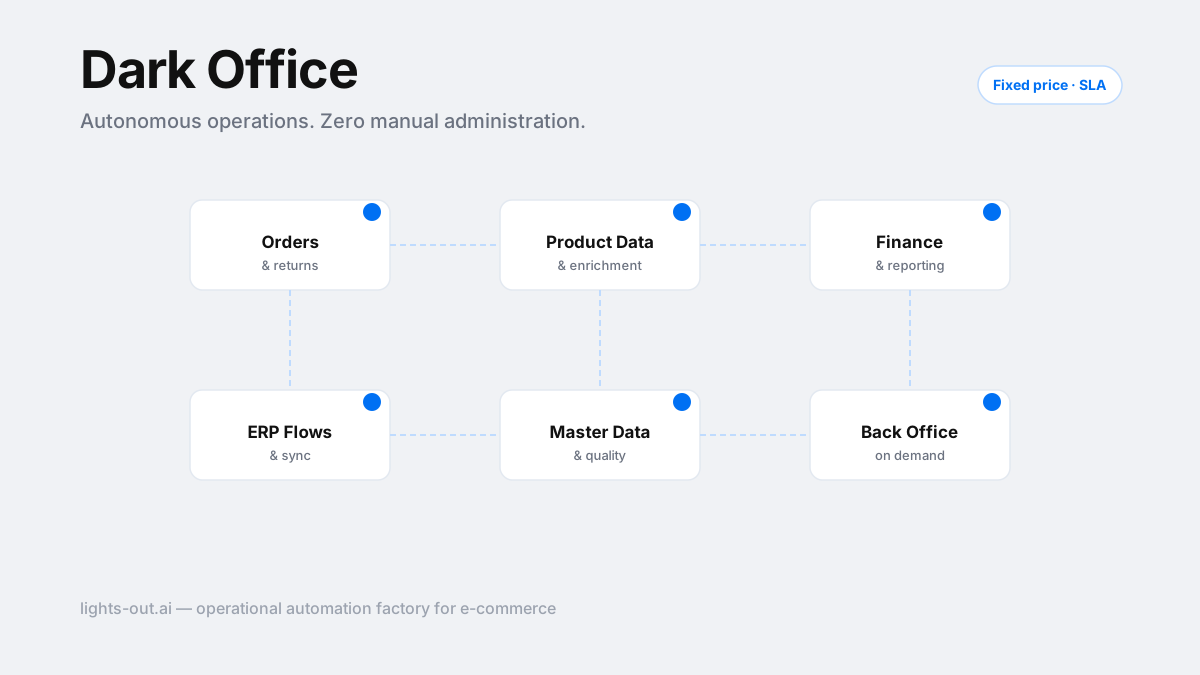
It takes roughly fourteen months to recruit, onboard, and reach full productivity for a back office employee. During that time, the company has spent close to a hundred thousand euros on salary for functions that are 70–80 percent standardizable transactions: invoice processing, data entry, status updates, reports generated every Monday. Then they leave. The cycle starts again.
Why internal AI programs make you slower first
The reflexive response is to give existing staff AI tools. ChatGPT, Copilot, specialized SaaS for specific workflows. The logic feels right: if AI handles part of the work, one person should manage more volume.
That is not what happens in practice. Research shows experienced teams often perform 15–20 percent worse during the first months of AI adoption. The phenomenon is called the J-curve. The cause is not that the tools are weak — it is that they are applied to processes designed for human execution. Meetings remain. Manual controls remain. Email chains remain. When AI generates work faster than the organization can validate it, a new bottleneck emerges — not in execution, but in review.
Escaping the J-curve internally requires redesigning processes from scratch, not adding an AI layer on top of the old design. That work requires system architecture to connect AI to legacy systems, the ability to write specifications precise enough to run without human interpretation, and orchestration of agent workflows. That is specialist capability costing 150,000 to 200,000 euros per year to keep in-house. Most SMBs do not have it — and cannot afford to wait until they do.
What "Dark Office" means in practice
Lights Out Manufacturing is a term from industry for factories that run without lighting: no people on the floor, robots working around the clock without breaks or sick days. Dark Office applies the same principle to administrative operations.
A Dark Office partner builds and operates a service factory — an environment where AI agents run defined transactions continuously with automated quality controls and SLA-backed outcomes. You are not outsourcing a person and not outsourcing a tool. You are outsourcing responsibility for a defined process to deliver correct output within a fixed time.
The pricing model differs fundamentally from traditional outsourcing. The cost of human staffing rises with inflation. The cost per AI transaction falls every quarter. A Dark Office partner absorbs the technological change on an ongoing basis. You pay per outcome, not per hour.
Which processes qualify
What works is high-volume, rule-bound processes with measurable output: invoice matching against purchase orders, product data enrichment before publishing, returns processing against defined policy, order status updates, price monitoring against market indices. The common characteristic is that correct output can be written down exactly. If you can write a specification for the process, an agent can run it.
It does not work for strategic decisions or situations requiring judgment in genuine edge cases. That is not an argument against automation — it is a definition of where automation is mature and profitable today.
The compounding gap
Klarna reduced headcount from 7,000 to 3,000 and attributes a large share of that reduction to converting back office functions into automated workflows. That is an option if you have the resources to invest tens of millions over three to four years.
For a company with 30 to 200 employees, the problem is different: the effect of automation is compounding. Every quarter a company runs manual processes at manual cost widens the gap against competitors who have automated. This is not about becoming an AI company. It is about operating on a cost base that remains competitive once your counterpart has made that move.
The standard counterargument is that the technology is still maturing and it is smarter to wait. It is true that the technology matures. But the cost of a premature internal build project is not lower because the technology matures — it is actually higher, because you pay a rebuild cost when you change direction twelve months from now.
What Lights Out offers
A Dark Office partner shares that risk. The investment in process design and agent infrastructure is already made. You pay for operations, not for the build. You avoid the J-curve and you avoid the capability risk.
That is the gap Lights Out fills. We map which of your processes are candidates, identify the quick wins, and then take operational responsibility with SLA. You buy the results. Not the build, not the J-curve, not the staffing risk.